

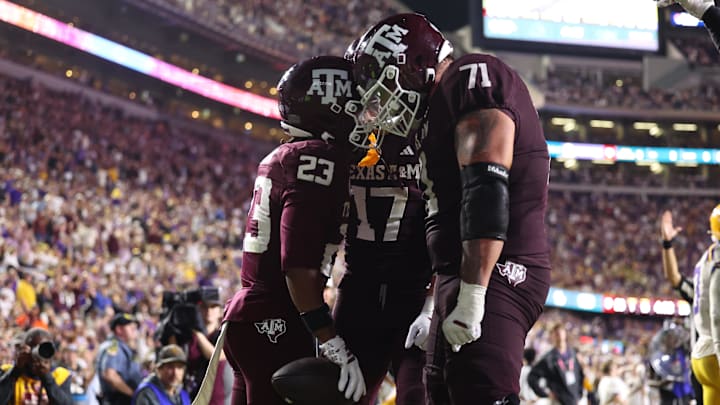
Texas A&M came into Tuesday night's initial CFP rankings with a hope at getting the top overall spot thanks to their stellar strength of record. This metric has been around for a while, but is newly being considered by the committee this year— it's a common-sense number that takes into account how well a team performed against the difficulty of their schedule, recognizing that not all 12-game slates are created equal.
Even with that number reportedly factoring in this year, the Aggies still landed at third in the first rankings— and A&M was all but entirely dismissed by Mack Rhoades, the committee spokesman, on the studio show following the rankings being revealed.
That baffling decision now may be explained by a recent thread on X. Adam McClintock, an expert on the CFP rankings who has been following them for quite some time, posted a breakdown of his projections vs. the committee's decision, showing the data that they were using— and something struck Aggie fans as quite odd.
CFP committee using wildly aberrant strength of schedule number to denigrate Aggies' record
Here's McClintock's breakdown of the committee's look at the Aggies— QW is quality wins, T25W is top 25 wins, SOS is strength of schedule, and GC is game control.
3 #TAMU #GigEm
— Adam McClintock (@cfb_professor) November 5, 2025
Projected Ranking: 3
3 QW
1 T25W
78 SOS
14.1 GC
The #Aggies have an opportunity to solidify a Playoff spot in the coming wks. That SOS is low but will rise. Keep that GC number where it is & they may sustain 1 L. 2Ls? Not as confident. Must keep winning.
The immediate alert for Aggie fans is seeing A&M's strength of schedule rated as 78th-best. This is, as McClintock explained in the replies, due to a formula that the committee themselves uses to measure strength of schedule.
The puzzling thing is that Texas A&M's strength of schedule is being marked as lower than that of Indiana or Ohio State— far lower, as a matter of fact. Indiana's ranked 35th, and Ohio State's ranked 23rd. This is completely incongruent with nearly every accepted measure of SOS, not only in order, but in magnitude.
Here are some examples: ESPN's FPI has A&M's schedule as 15th-toughest in the nation. Ohio State's is 32nd, and Indiana's is 38th. SP+ sees A&M as having the 17th-toughest schedule, with Indiana at 31 and Ohio State at 38. FEI uses three separate metrics (how an average, good, and elite team would fare against a given schedule), and A&M ranks well above both Indiana and Ohio State in two of the three— Indiana has a slight edge in one. Kelley Ford's KFord Ratings have A&M at 15th, Indiana at 49th, and Ohio State at 51st.
Yet, somehow, the committee currently sees Indiana's SOS as 43 spots better than A&M and Ohio State as 55 spots better. That explains how they could rank A&M below both of those teams despite the Aggies achieving more up until this point.
This argument is not tempered at all by an insistence that this SOS number is meant to only measure the season up until this point; if that were the case, with Indiana, Ohio State, and Texas A&M all having identical records, you would expect the Aggies' SOR— which explicitly only measures what has already been achieved— in these instances to be unanimously much lower than these other two teams; yet the Aggies lead in that metric per most of the numbers I used above.
This is hard to explain for the committee, and does not speak highly of their grasp on the sport. If they truly view the Aggies' strength of schedule up until this point as so far below these other two teams, then it's hard to trust that they'll exercise anything close to sound judgment moving forward.
 Add us as a preferred source on Google