

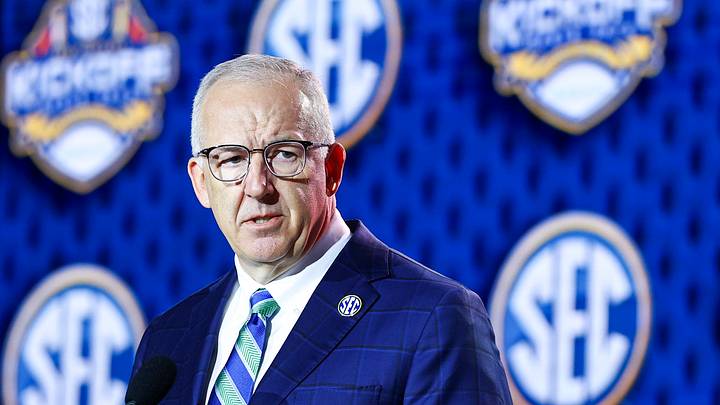
The SEC announced yesterday that they would be penalizing any program which attempts to deploy players who have previously signed professional contracts in the NFL, NBA, G-League, or WNBA. This announcement comes on the heels of Lane Kiffin and LSU attempting to bring two former Ole Miss players onto their roster, Dae'Quan Wright and Zxavien Harris, who had signed with NFL teams beforehand.
The SEC's rule is an effective rejoinder to the strategy that Kiffin and the Tigers were attempting to take, though there's been some noise that they may attempt to challenge that rule (this despite the fact that the 16-0 vote in favor of it indicated that LSU's president acquiesced). However, the added language that bans basketball players from returning to college if they have been part of an NBA or G-League organization comes at a cost to Bucky McMillan and company.
This rule would preclude former G-League guard Bryson Warren, who McMillan and company wanted to see as a big part of the team this year, from participating for the Aggies. Though most were behind the SEC smacking down Kiffin's antics, there was some thought that it might be worth challenging at least the G-League portion of this, as this rule doesn't— for example— stop teams from signing players who played professionally overseas, but the penalties the SEC just enummerated for breaking this rule might be enough to deter that line of thought entirely.
SEC lays down the law with harsh penalties for schools who try to use former pro players
The immediate word after the rule was passed was that Greg Sankey had been granted "full latitude" to enforce the rule, but the details that have just come out are enough to completely scare off any team who was considering breaking the rule en route to a courtroom challenge:
NEW: Schools that violate the SEC's professional sports rule will result in:
— On3 (@On3) August 26, 2026
• 50% season suspension for head coaches
• 50% of that sport's annual operating budget
• SEC voting privileges on business matters revoked
(per @walexander) https://t.co/ilGhLr1QS2 https://t.co/DH7x0qXgba pic.twitter.com/Vyv3x8buyW
While that is not quite the death penalty, it's close enough to effectively deter even an institution like LSU from forging ahead with their subterfuge. That also means that the Aggies had better watch their step in Warren's case so as not to bring down the wrath of Sankey and the conference upon their basketball team.
Warren was just granted a Temporary Restraining Order against the NCAA in his ongoing court case, meaning that, save for this new rule from the conference, he would otherwise be eligible to play— just like Rashaun Agee last year. While that previously seemed like it was the major hurdle, now it is clear that the bigger barrier for Warren is going to be the SEC's block to his participation.
Do the Aggies dare challenge this themselves? There are other schools who have players they want to get eligible in defiance of this new stricture, so it may be best to let those institutions attempt to do so first and see what prudence dictates in the fallout. Texas A&M, just like every other school, could ill-afford such a blow to their coaching staff, budget, and authority to vote in the conference, so discretion might be the better part of valor here.
 Add us as a preferred source on Google