

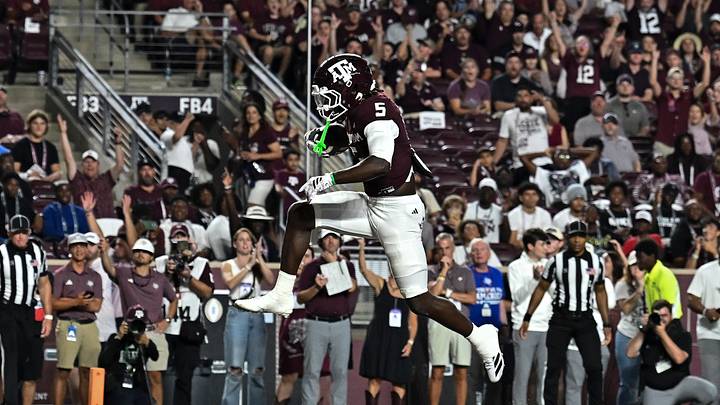
Texas A&M's domination of Missouri State was one of the most impressive displays of week one in college football, whether or not fans want to believe it. LSU's destruction of Clemson got a lot of headlines, and deservedly so, but when it comes to how massive the destruction was of an opponent, no one did that better than the Aggies in week one.
This chart, put out by Parker Fleming every week, shows the difference in success rate between teams and their opponents in a given game. Success rate is an advanced statistic that shows how well a team is able to keep on schedule on offense, or "stay ahead of the chains," and having a better success rate than your opponent in a given game is highly correlated to winning.
📊🏈DID WE REALLY GET BEAT THAT BAD?
— parker fleming (@statsowar) September 8, 2026
Net Success Rates in Week 1 pic.twitter.com/Z0OVR2dzYs
As you can see, the Aggies had the greatest net success rate of any team in the nation in week one. This is a deeper and better look at how dominant a team was than simply the score differential— this shows that the Bears were just unable to move the ball at all on the Aggies.
Texas A&M's domination of Missouri State in week one actually was that impressive
Compare this to a team like Texas, who had a larger final score differential, but a much lower— pedestrian, even— net success rate. Their win over Texas State compares better to Colorado State's over Wyoming, or Duke's over Tulane— UMass over Rutgers was more dominating than Texas was over the Bobcats.
This net success rate gives a full-team picture of dominance, as well. If your team is highly successful on offense, hardly registering any negative or "meh" plays, but your defense is getting shredded regularly, then your net success rate will not be very high. If you have only a B+ game on offense but your defense absolutely chokes out the opposition— which is how most fans feel about the Aggies' performance— then your net success rate will look great.
There's really no doubt that this high net success rate for Texas A&M is thanks to what their defense did. The Aggies didn't allow Missouri State, who very well could end up having a pretty potent offense this year, to do a single thing against them— a refreshing change from how game one looked last year against UTSA.
The thing about using success rate is that it translates better as a predictive measure than simply looking at the final score. There are all sorts of reasons why teams get to the scores that they do in games, and using success rate in this way helps provide some context to it. Texas A&M, Ohio State, and South Carolina all dominated their opponents thoroughly— Alabama and Indiana did okay, but not great.
While this is only one week, and it's against a low-level opponent, we can say that the Aggies looked the part of an elite team in that small sample size. That's no guarantee that that will continue— the game against Arizona State this weekend will tell us a lot more— but the Aggies passed this first checkpoint with flying colors.
 Add us as a preferred source on Google